
Description
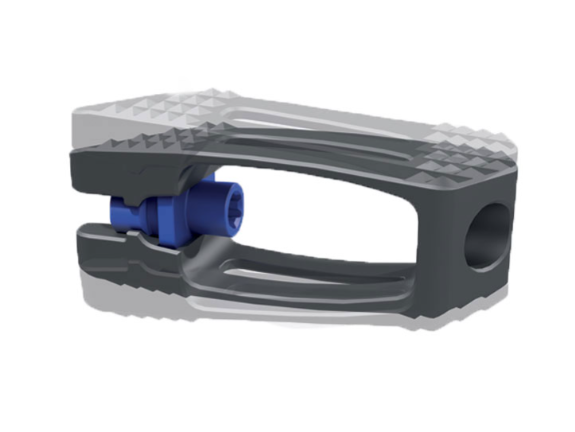
VERTACONNECT by SIGNUS is a lumbar interbody fusion system designed for implantation through a transforaminal TLIF approach at spinal levels L1-S1. It is an expandable cage manufactured from biocompatible Ti-6Al-4V titanium alloy and is intended to provide structural support within the prepared intervertebral space while creating suitable mechanical conditions for fusion between two adjacent vertebral bodies.
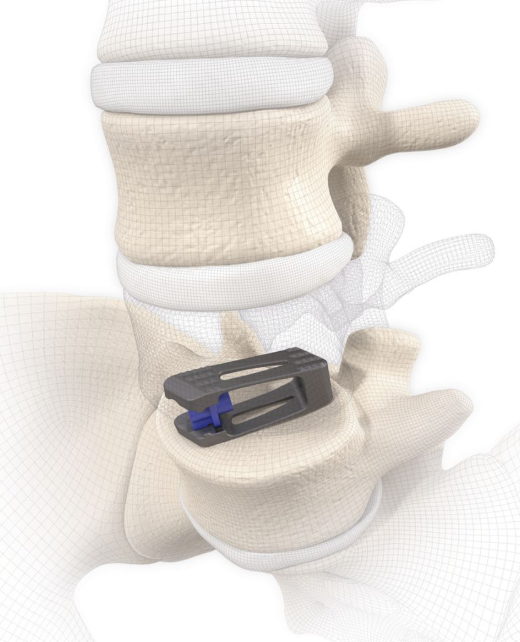
The implant is introduced with a reduced anterior height and expanded after reaching its planned position within the intervertebral space. Expansion occurs in the ventral portion of the cage, increasing its anterior height and lordotic angle while maintaining the selected posterior height. This allows the implant to adapt to individual patient anatomy and supports restoration of intervertebral height and sagittal alignment.
VERTACONNECT is positioned diagonally to utilize the available length across the vertebral endplates. This orientation provides a large contact area and enables implantation in a single step without requiring the complex rotational maneuvers associated with certain curved or banana-shaped cages.
The implant features a large fenestration and an open architecture that allow it to be filled with autologous bone or an appropriate synthetic bone substitute. These openings facilitate contact between the graft material and the prepared vertebral endplates, allowing bone infiltration through the implant.
VERTACONNECT is intended for use with suitable supplemental posterior instrumentation to provide immediate biomechanical stabilization of the treated segment. Implant selection, positioning, expansion, and graft filling must be determined by a qualified spine surgeon according to the patient’s anatomy, pathology, and surgical plan.
INDICATIONS
VERTACONNECT may be used for lumbar interbody fusion between L1 and S1 in patients with the following conditions:
- Lumbar degenerative disc disease.
- Disc herniation.
- Mechanical instability of the lumbar segment.
- Lumbar spinal canal stenosis.
- Grade I or Grade II spondylolisthesis.
- Lumbar pseudarthrosis.
- Loss of intervertebral height associated with the indicated conditions.
- Sagittal imbalance requiring reconstruction through interbody fusion.
- Cases in which stabilization and fusion are considered necessary after appropriate nonsurgical treatment options have been exhausted.
The surgical indication must be established individually following a complete clinical and radiological assessment. The implant is intended exclusively for use by healthcare professionals specializing in spinal surgery.
EFFECT AND TECHNOLOGY
- Expandable cage designed for transforaminal lumbar interbody fusion.
- Manufactured from biocompatible Ti-6Al-4V titanium alloy.
- Designed for implantation in the L1-S1 lumbar region.
- Its low insertion height facilitates access to the prepared intervertebral space.
- Anterior expansion increases the ventral height of the implant after placement.
- Provides two lordotic configurations to accommodate different anatomical requirements.
- Its biconvex shape supports adaptation to the vertebral endplates.
- Helps restore intervertebral disc height.
- Supports reconstruction of the sagittal alignment of the treated segment.
- Diagonal placement utilizes the available length across the vertebral body.
- Single-step insertion avoids the need to rotate the cage within the disc space.
- Its large contact area supports more uniform load distribution.
- The broad support area helps reduce the risk of implant subsidence.
- Toothed surfaces provide anchorage and primary stability.
- The surface teeth help reduce the risk of cage migration.
- Its open architecture accommodates autologous bone or synthetic bone graft material.
- The large fenestration facilitates cage filling following placement and expansion.
- Openings allow the graft material to contact the prepared vertebral endplates.
- The design supports bone infiltration through the internal space of the implant.
- Multiple lengths, posterior heights, and angles provide intraoperative flexibility.
- Trial implants allow posterior height and length to be assessed before opening the definitive implant.
- Implant positioning and expansion can be verified under radiographic imaging.
- Used with supplemental posterior instrumentation to stabilize the treated segment.
- Supplied sterile and intended for single use.
VERTACONNECT should not be used when bone quality prevents stable implant anchorage, as may occur in certain cases of osteoporosis or osteomalacia, or in the presence of infection, spinal tumor, material intolerance, or another contraindication stated in the instructions for use. It should not be combined with instruments or components not authorized by the manufacturer.
Reviews
There are no reviews yet.